
News & Events

News & Events
UTS Family Sport Day 2026 “Eagles Run, Eagles Go Beyond” officially returns
The annual UTS Family Sport Day 2026 will bring a vibrant celebration where families can run together and connect with the UTS community.

News & Events
“Hands-on” methodology – Excite creativity and help children enjoy learning
In recent years, the education sector in general and schools have made great efforts to reform the quality of teaching and learning in the natural sciences. With the teaching philosophy of putting Students at the Center”, the US Vietnam Talent International School has applied the method “Hands-on” at the high school level to help students be independent, creative, take initativesinitiatives and solve problems. Besides, this method also helps teachers improve the quality of teaching. “Hands-on” methodology is the way the teacher organizes for students to self-study to find solutions to the knowledge in the curriculum through proposing, discussing, and performing experiments. The steps to organizing classes according to this method include: Stage 1: The starting situation and the question raises the issue. Teachers will proactively set a starting or questionable situation as a starting point to the lesson. The foreboding circumstances are brief, close to students and practice making questions raises the issue at the same time. Problem question which is the big question of the lesson itself (or module of knowledges that students will be taught) need to ensure suitable to students’ level, arouse curiosity and researching interest of the students to equip them with studious psych sphere before perceiving sciolism. Teachers should use open questions instead of closed ones (Yes-No question) in terms of problem questions. It also must meet all the requirements that were mentioned before, so that the teaching scheme of the teachers will be more successful. Stage 2: Expressing the beginning opinions of students In this stage, teachers will encourage the students to express thoughts and raise their awareness before learning new things. To raise the starting conception from the students, teachers can request their students to remind the previous lessons that alike with knowledge of the current lesson. When requesting students to express the started awareness, students can

News & Events
Space repetition method – Best “tips” for the exam season
Exam season has come very close. How far have UTS-ers reviewed? Has anyone ever memorized a lot the night before, only to forget a lot the next morning, leaving us extremely confused while reviewing and also while sitting the exam? UTS has found the “key” to overcome this problem, which is to use the method of spaced repetition. Thanks to this method, we have reviewed almost all the lessons and still remember them for a long time. Let UTS reveal to you a little about the method of spaced repetition. The method of spaced repetition is applied based on the psychological effect of interruption, as defined by Hermann Ebbinghaus, a famous German Psychologist. His research shows that the set of knowledge we learn in a certain period of time will be memorized in people’s short-term memories and quickly forgotten, just like in our review story. But when we repeat the same content many times at different times, our brain will put that amount of information into long-term memory, helping us remember longer. UTS will give a specific example. Normally we need 1 night to learn all the knowledge needed for the next day’s exam, but when using the spaced repetition method, you only need 30 minutes to study in the morning. At noon, 10 minutes of review in the evening, and 10 minutes of re-reading the next morning, in total, we only need about 40 minutes to remember the knowledge clearly, effectively, and long-term. This method can help you memorize a large amount of information and store it for a long time. The spaced repetition method can be applied and is effective in many different subjects and contexts. However, this method has a special impact when used to study and practice language subjects. A concrete example is learning
News & Events
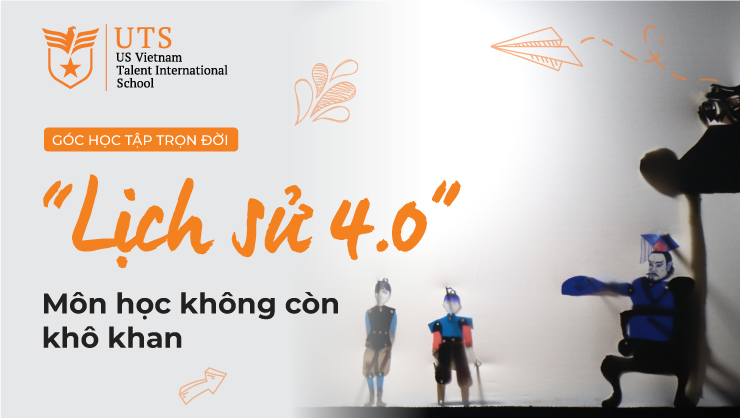
HISTORY 4.0 – THE SEEMINGLY BORING SUBJECT BECOMES MORE INTERESTING THAN EVER!
Research of Master Tran Vu LinhUS Vietnam Talent International School Teacher The subject History was often considered quite boring, “difficult” for many students because the amount of knowledge to remember is quite “massive” as well as the characteristics of the subject is difficult to associate with modern reality. Therefore, the teachers of History are constantly exploring and improving new and interesting teaching methods to help students acquire knowledge more effectively. And at UTS, the History teacher has implemented a very unique method: “Applying the art of shadow play in teaching History”. The application of shadow play to teaching, especially the teaching of History in high schools is very new. US Vietnam Talent International School is the first international school in Ho Chi Minh City to pioneer the introduction of shadow play into teaching history and initially achieve encouraging results. The project “Applying the art of shadow play in history teaching” was implemented for the first time in the 2020-2021 school year with the participation of 34 students in grades 10 and 11. After 2 months of implementation, the students completed four works with the content of two themes: “Resistance against foreign invaders from the 10th-15th century” and “World War”. These are the first works, which uts teachers and students devote a lot of enthusiasm and investment both in form and content. Although the knowledge and experience of shadow play is still limited, the products the students create are still extremely impressive and convey the story and historical context as the theme. The goal of the learning project is to both stick to the standard of knowledge, while aiming to build an exciting training space for History and learn the specific skills of shadow play. Therefore, while writing the shadow play script, the students need to ensure the following