
“Hands-on” methodology – Excite creativity and help children enjoy learning

“HANDS-ON” METHODOLOGY- EXCITE CREATIVITY AND HELP CHILDREN ENJOY LEARNING.

In recent years, the education sector in general and schools have made great efforts to reform the quality of teaching and learning in the natural sciences. With the teaching philosophy of putting Students at the Center”, the US Vietnam Talent International School has applied the method “Hands-on” at the high school level to help students be independent, creative, take initativesinitiatives and solve problems. Besides, this method also helps teachers improve the quality of teaching. 

“Hands-on” methodology is the way the teacher organizes for students to self-study to find solutions to the knowledge in the curriculum through proposing, discussing, and performing experiments. 

The steps to organizing classes according to this method include: 

Stage 1: The starting situation and the question raises the issue. 

Teachers will proactively set a starting or questionable situation as a starting point to the lesson. The foreboding circumstances are brief, close to students and practice making questions raises the issue at the same time. 

Problem question which is the big question of the lesson itself (or module of knowledges that students will be taught) need to ensure suitable to students’ level, arouse curiosity and researching interest of the students to equip them with studious psych sphere before perceiving sciolism. 

Teachers should use open questions instead of closed ones (Yes-No question) in terms of problem questions. It also must meet all the requirements that were mentioned before, so that the teaching scheme of the teachers will be more successful. 


Stage 2: Expressing the beginning opinions of students  

In this stage, teachers will encourage the students to express thoughts and raise their awareness before learning new things. To raise the starting conception from the students, teachers can request their students to remind the previous lessons that alike with knowledge of the current lesson. When requesting students to express the started awareness, students can be required using various expression forms such as verbal (through personal states), by writing or drawing to express thoughts. 

From all the started original opinions from the students, teachers must be skillful in helping students to ask questions. Furthermore, teachers must focus on the conception interdepended with the lesson content. 


Stage 3: Offering questions or hypothesis and design experimental plans 

From the proposed previous questions, teachers ask some questions, students are propounded to express their hypothesis and design experimental plans, full-searching plans to verify all their theories and find the answers. The full-searching plans that mentioned before are options to find out the answers, such as introspecting, doing experiments 


Depending on the knowledge or problem posed, students can propose different research-experiment options. In the process of proposing the experimental plan, if the student’s opinion is correct but the language is not standard or the expression is not clear, the teacher should suggest and help students step-by-step improve the expression. This method encourages students to self-assess each other’s ideas rather than the teacher’s. 

Step 4: Carry out research-experimentation 

From the experimental research, investigation, and research options raised by students, the teacher skillfully comments on and chooses appropriate experimental equipment or teaching equipment. suitable for students to conduct research. If experiments must be performed, it is preferable to perform experiments directly on real objects. In some cases where it is not possible to conduct experiments on real objects, they can be done on models or for students to observe drawings. 

For the observation method, teachers let students observe real objects first, then let them observe scientific drawings or models to enlarge features that cannot be clearly observed on real objects. When conducting an experiment, the teacher clearly states the requirements and purpose of the experiment or asks the students to indicate the purpose of the experiment to be conducted. 

Experiments are conducted in turns, corresponding to each knowledge module. After each experiment is done, the teacher should pause for the students to draw conclusions (i.e., find the answers to the corresponding problems). The teacher reminds students to record experimental materials, the layout and implementation of the experiment (describe it in words or draw a diagram), note down the results of the experiment, and the conclusion after the experiment in the actual notebook. 

For complex experiments, and if possible, teachers should design a ready-made template for students to fill in with experimental results and experimental materials. When performing individual or group independent practice, it helps students avoid seeing and doing things in each other’s way, being passive in thinking, and it also makes it easier for teachers to detect groups or individuals who excel in performing experiments. Research experiments, especially experiments performed with the same experimental equipment and materials, are generally accepted, but if the experimental arrangement is not reasonable, the desired experimental results will not be obtained. 

Step 5: Concluding and validating knowledge 

After conducting research-investigation experiments, answers are gradually solved, hypotheses are tested, and knowledge is formed, but it is still unsystematic or not scientifically accurate. The teacher is responsible for summarizing, concluding, and systematizing the material for students to record in their notebooks as knowledge of the lesson. Teachers inculcate knowledge for students by allowing students to look back and compare their original ideas (original conceptions) before learning knowledge. 

Thus, from the wrong initial conceptions, after the experimental process of finding and researching, the students themselves discover that they are wrong or right, but not by the teacher’s judgment. Students themselves detect deviations in perception and self-correct and change proactively. These changes will help students remember longer and deepen their knowledge. 

The use of the “hands-on” method in teaching natural sciences is a typical method to help students gain skills such as observing, experimenting, explaining phenomena, and applying knowledge in real-life economics. During the experiment, students not only develop observation skills but also develop the ability to conduct experiments. From there, the necessary experience can be drawn so as not to make mistakes in subsequent activities. This method also helps students improve their ability to express themselves, develop scientific language, and gives them the opportunity to form and develop teamwork skills, making the class more united and cohesive. Since then, students have become more interested and enthusiastic about the subject, resulting in higher learning efficiency. 

UTS believes that being flexible in applying learning methods will help students have the best opportunity and environment to express and create their own “world,” grow up and maximize their potential. There is potential for personal success and happiness. 
Tin tức khác
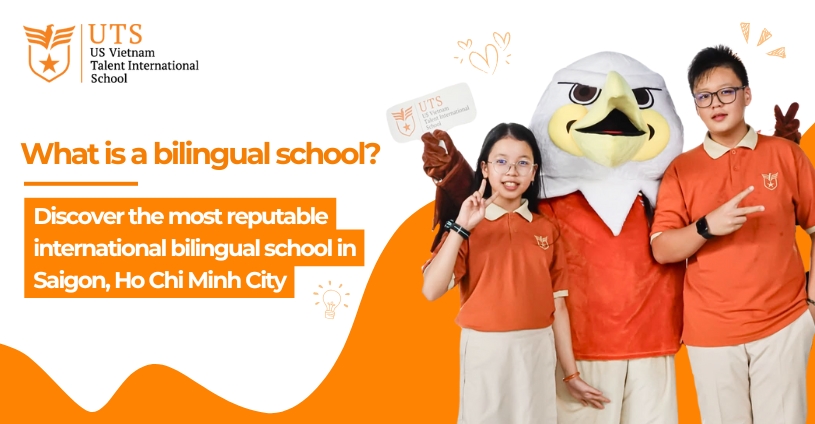
What is a bilingual school? Discover the most reputable international bilingual school in Saigon, Ho Chi Minh City

News & Events

What is a bilingual school? Discover the most reputable international bilingual school in Saigon, Ho Chi Minh City

Bilingual education is becoming a key trend in Ho Chi Minh City, with an increasing number of schools established to meet parents’ needs. This model combines domestic and international programs, helping students develop flexible thinking, master languages, and gain skills for global integration. What is a Bilingual School? A bilingual school is an educational model that delivers instruction in two languages, most commonly Vietnamese, and an international language such as English, French, or German. According to the National Institute of Child Health and Human Development (NICHD, USA), children who learn in a bilingual environment tend to have more flexible thinking, better memory, and superior problem-solving skills compared to those who only use one language. Not only does bilingual education provide personal benefits, but it also enhances job opportunities and strengthens a nation’s ability to integrate globally. This is why the trend of enrolling children in bilingual schools is on the rise in Ho Chi Minh City, especially among families planning for overseas study or careers in international environments. Key features and operational models of Bilingual Schools Key features of Bilingual Schools in Ho Chi Minh City The rapid growth of bilingual schools raises the question: “What makes this educational model so appealing?” Let’s explore the key factors that set bilingual schools apart: Curriculum Bilingual schools follow an integrated learning model, using both Vietnamese and a foreign language for core subjects. Popular programs include the Oxford International Curriculum, the Common Core (U.S.), Cambridge, or customized bilingual programs. Additionally, diverse extracurricular activities such as sports, arts, and soft skills clubs help students develop comprehensively. Continuous learning pathway Bilingual schools provide a multi-level education system, ensuring a stable learning journey. With a structured knowledge acquisition process and a natural language environment, students are well-prepared for higher education, either domestically or abroad, while reducing
Wonders Quest English Camp: Super Talent Squad
News & Events

Wonders Quest English Camp: Super Talent Squad

Wonders Quest English Camp: Super Talent Squad    Awaken the “wonder” inside every child at the Wonders Quest English – Skills – Moving Camp at UTS. WONDERS QUEST ENGLISH CAMP May 22, 2022 Age: Grade 1- 12 (Academic year 2022-2023) Location:  US Vietnam Talent International School Date: May 22, 2022 Language: English   In modern life where it is easy to connect with electronic devices, children gradually “lose connection” to the outside world. Especially in times of social distancing, children are “stolen” the opportunity to play and move, while this is the most effective way for children to develop their thinking and social skills. An experiential day at Wonders Quest is a day to have fun, participate in the race to explore the “wonders” at UTS and conquer many exciting challenges. From there, children can find the “wonder” inside themselves by developing thinking skills, language, critical thinking, mobility and teamwork.   NHỮNG HOẠT ĐỘNG NỔI BẬT LỊCH TRÌNH SỰ KIỆN DETAIL INFO Thời gian: Học sinh từ Lớp 1 – Lớp 3: 8:00 – 12:00, 22/05/2022 Học sinh từ Lớp 4 – Lớp 12: 08:00 – 17:00, 22/05/2022. Địa điểm: Trường Quốc tế Nam Mỹ UTS Cổng 1: 69/68 Đặng Thùy Trâm, Phường 13, Quận Bình Thạnh, TP.HCM. Cổng 2: 80/68 Dương Quảng Hàm, Phường 5, Quận Gò Vấp, TP.HCM. CONTACT Hotline: (028) 710 78887 hoặc 091 938 1221 Email: info@utschool.edu.vn Website: https://utschool.edu.vn/ Facebook: facebook.com/NamMyUTS/  
UTS Summer Program 2024: BE AN EXPLORER
News & Events

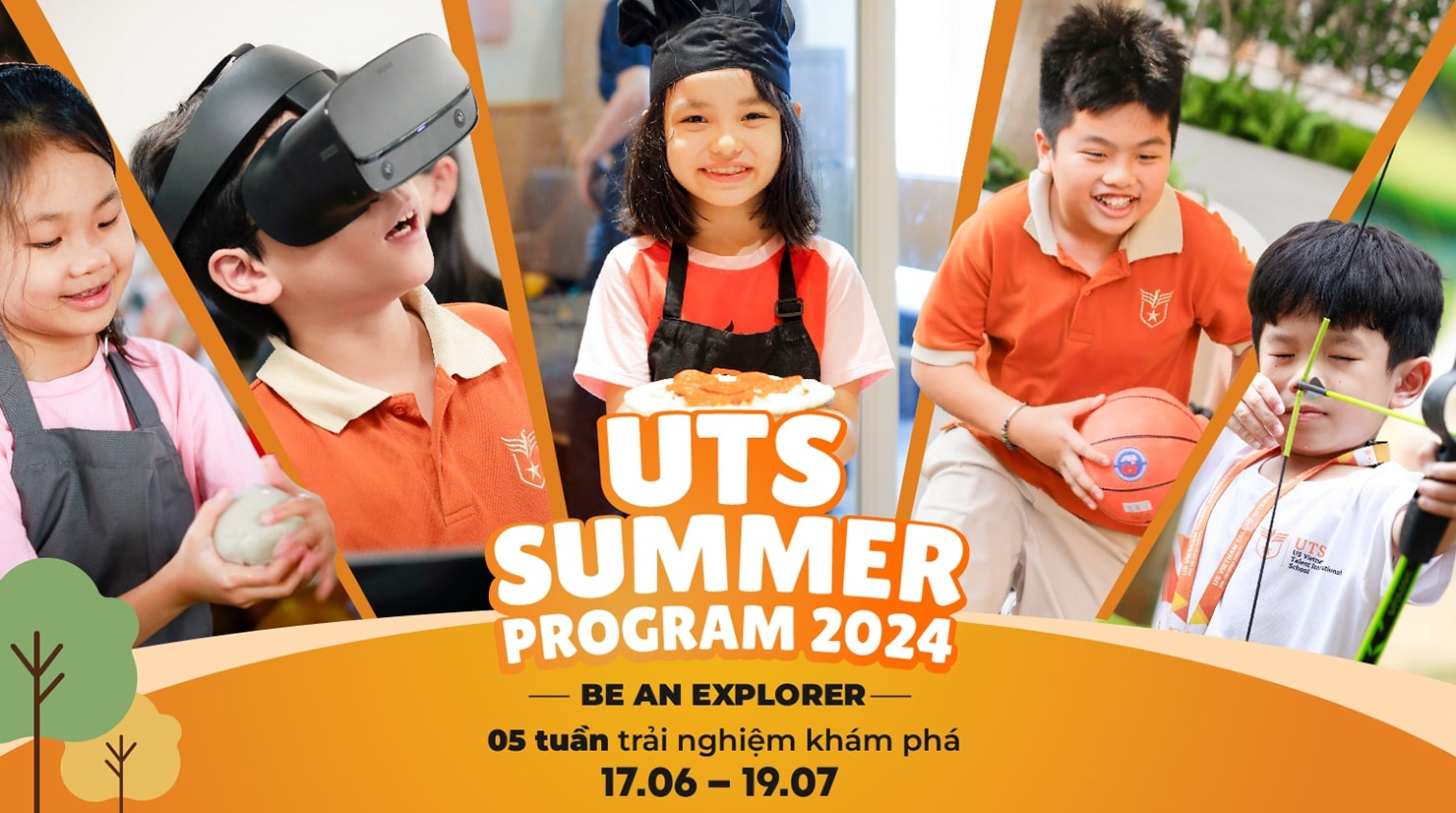
UTS Summer Program 2024: BE AN EXPLORER

UTS Summer Program 2024: BE AN EXPLORER A dynamic summer – where students are free to explore and experience countless amazing things from their personal traits to interesting puzzle pieces about the world! And all these marvelous and outstanding experiences is now gathering at UTS Summer Program 2024 – “Be An Explorer” at UTS. The UTS SUMMER PROGRAM 2024: BE AN EXPLORER is something parents shouldn’t miss! The program runs for five weeks from June 17 to July 19 for all Primary and Secondary students. At UTS, students can explore themselves and the world around them through one-of-a-kind weekly topics: Week 01: Me, Myself, and I – Knowing who they are helps students plan their next move more precisely and easily. Week 02: Me and My World – Step outside to the world, engage with different people in the community, and learn about the connections around you. Week 03: Going Places – Broadening their viewpoints to the new horizons of knowledge, where there are values that might surprise them. Week 04: The World of Wildlife – Going back to Mother Nature to experience the wealth of wildlife. Week 05: Taste of The World – Learning about nutrition science and take care of our own health. Aside from productive learning time, students also participate in engaging activities and off campus experiential learning trips every Friday. Five exploratory weeks – Five new horizons, only in UTS Summer Program 2024: BE AN EXPLORER
Santa’s Creative Workshop
News & Events

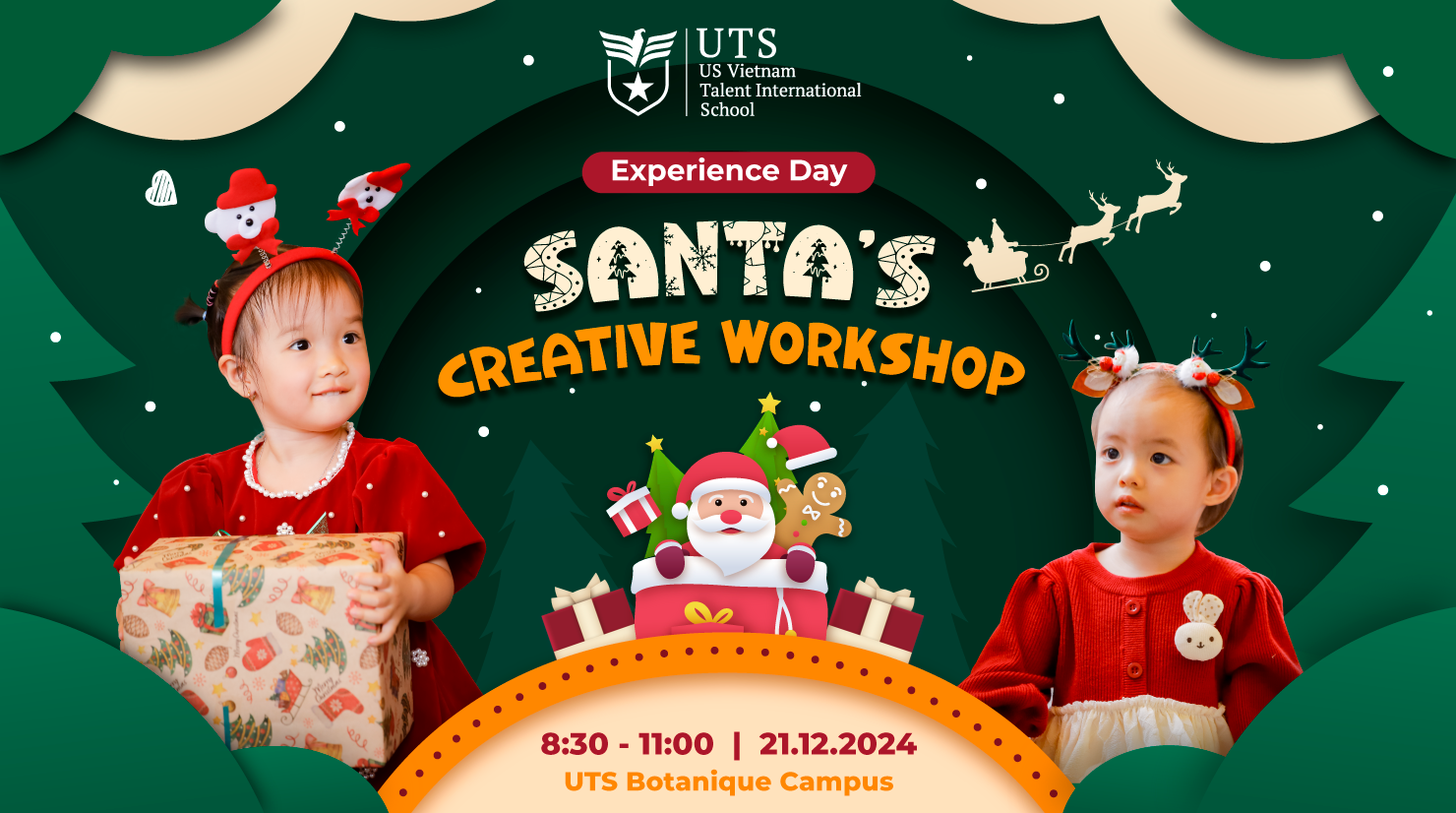
Santa’s Creative Workshop

Christmas is coming to town…  ❄️ Christmas is the most anticipated holiday of the year – a time when families come together to create cherished memories amid the crisp winter air and an atmosphere filled with love. This festive season, The Southern International School UTS warmly invites Parents and Children to visit Santa’s cozy “home” and take part in joyful activities at Santa’s Creative Workshop, held at the lush UTS Botanique Campus. It’s a perfect occasion for the whole family to get creative and enjoy meaningful holiday experiences:  ⛄ Holiday Art Creations: Children and parents will craft colorful Christmas characters, adding their personal touch to the festive spirit.  Parent Workshop – “UTS Little Ones and the Green School in the Heart of the City”: Parents are invited to discover how UTS nurtures happy and confident young learners through a thoughtful educational journey.  Surprise Gifts from Santa Claus: Every child visiting the creative workshop will receive a special gift from Santa – a warm holiday wish wrapped in joy.  Event Details:  Time: 8:30 – 11:00 AM, Saturday, December 21, 2024   Location: UTS – The Southern International School, Botanique Campus (360D Ben Van Don, Vinh Hoi Ward, HCMC – inside Khanh Hoi 1 Apartment Complex).  Register at: https://zfrmz.com/1FbeDeKhlbUJeOoFwjZx  This event is completely FREE with limited slots available. Don’t miss out, register now and treat your child to a magical, joy-filled Christmas celebration at UTS!
School Play’s Premier “Snow White And The Seven Entrepreneurs”
News & Events

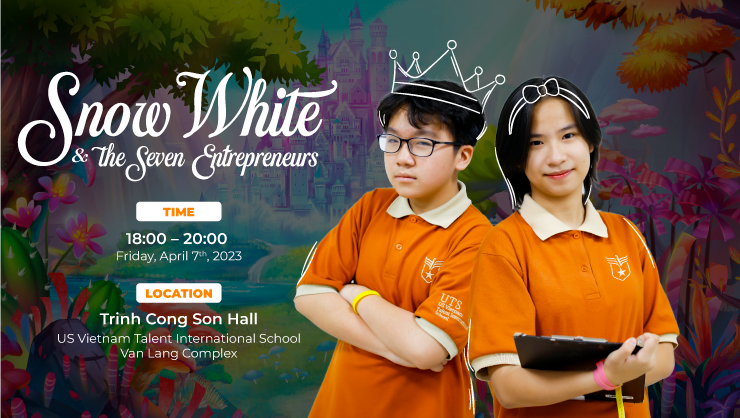
School Play’s Premier “Snow White And The Seven Entrepreneurs”

School Play’s Premier “Snow White And The Seven Entrepreneurs”   Our modern twist is set in a progressive forest, where the question is not “Who has the most beauty of them all?”, but “Who has the most business?”, and above all else, banh mi! The story begins after Snow White has recently left a dead-end job at the Old Castle to kickstart her dream of owning her own business. The Evil Queen, who was her most recent employer, has turned bitter from jealousy at Snow White’s newfound success.  How is her life without the help of fairies and magical wands? Everything will be unveiled in the school play “Snow White & the Seven Entrepreneurs” with the participate of UTS Students from Performing Arts Club. This performance will allow students a unique opportunity to express their individuality in performing arts, develop their stage presence, practice their linguistic skills, and of course gain invaluable experience of theatrical productions. INFORMATION ABOUT THE PREMIERE Language: English Time: 6.00pm Friday, April 7th, 2023 Venue: Trinh Cong Son Auditorium, UTS Van Lang Complex Ticket price: 150,000 VND Ticket Booking: Choose your seats and buy tickets at the Admission Office, UTS Van Lang Complex The school hopes to receive the love and support of the parents as our performers embark on their very first English-speaking play. Tickets are available for any family, friends and supporters to come and enjoy the show as audience members. Every ticket includes a lucky raffle ticket number, with the prize draw taking place during the performance intermission. Half of the proceeds from the ticket sales and concessions stand will be directed to the operating budget of the UTS Performing Arts Club and the other half to UTS’s community activities. We are incredibly proud of our performing stars and their efforts so far, so